
Lotto Combination 1 2 3 4 5 6: Probability, Frequency, Odds, Statistics
Standard deviation rules the lottery as well!
By Ion Saliu, Founder of Lottery Mathematics

We can hear two divisive opinions:
1: "Lotto combination 1-2-3-4-5-6 has the same chance of being drawn as any other lottery combination. I play it religiously!"
2: "NO, NO, NO! Lotto combination 1,2,3,4,5,6 should not be played. It represents a weird arrangement of lottery numbers. Only fools can waste their money and play such a combination!"
It is the kind of issue that pits brother/sister against brother/sister, and enemy against foe...not to mention friend against lover. Incidentally, the lottery combination 1-2-3-4-5-6 is played by thousands of lotto players worldwide in any drawing. Thusly, if you win the jackpot, the value of the prize would be “tragically” worse than meager! If one hits the lotto jackpot, one expects to turn into a never-work-for-others freak. If that's the goal, be advised to never play the statistically dreadful 1 2 3 4 5 6!
I was also strongly opinionated in this regard. Let us start with the fundamental concept of probability. If the 6/49 lotto has a total of 13,983,816 combinations, and only one is drawn as the winner, the probability is undeniably 1 / 13,983,816. It is also expressed as 1 in 13,983,816; or, as odds: 13,983,816 to 1 (even as 13,983,815 to 1). The relations are mathematically valid. But the probability is rather an abstract concept. We can infuse more life into probability if we look at the probability as:
Expected number of successes in one trial.
This explains more clearly the requirement that the probability cannot be larger than 1. No event can have more than one success in one trial! Very logical — or is it? NOT! Most people confuse probability for degree of certainty! You need read more (at this Web site) on the essential distinction between probability and degree of certainty.
Successes and trials are real elements, not abstract concepts. All real-life random events are characterized by successes and trials. Real-life random events do not deal with simply one success in one trial. Life is a whole lot more complex than that.
I presented on one of my Web pages (Gambling, Lottery Analysis: Odds, House Edge, Fraud) the reality of lottery combinations. In the pick-3 lottery game, every combination has the same probability: 1/1000. Yet, some pick 3 lottery combinations have come out ten or more times, while another combination waited for over 6000 draws to see the daylight! (Real case: combination 2 1 4 in Pennsylvania Lottery.)
The discrepancy is much wider in 6-number lotto games. The higher the odds (or lower the probability), the wider the frequency gap. I said previously that we were never ever to see equal frequencies in lotto games. Test it for billions of draws! I know, we were not built by beloved Mother Nature to live that long. But we can use computers to generate that many gazillions of combinations. Never — ever — will we see equal frequencies of combinations — extremely rarely, that is!
But what's wrong with a lotto combination like 1-2-3-4-5-6? Why shouldn't it come out even more frequently than combinations considered to be “more random”? For example, 3,17,28,29,34,47 is considered by many more likely to be drawn because appears to be ”more random” (sic!) I think more random has come to life as a result of statistical analysis of lottery draws. In truth, everything is random... the Universe is random!
It can turn into a very complicated debate. I will make it as simple as possible. The simplest way and the clearest method of proving or disproving is data analysis. They say ”A picture is worth a thousand words”. Also, Real data is worth millions of words. I will add to analysis 6 more lotto numbers. That way, we can analyze real draws that occurred in our lifetime. Many lotto players also play combinations like 7,8,9,10,11,12. I saw with my own eyes a Jamaican lottery player (a farm worker in the US, as I was up until mid 1990s) always starting his play card this way:
1,2,3,4,5,6
7,8,9,10,11,12
I will do the analysis for 12 "lotto" numbers: 1,2,3,4,5,6,7,8,9,10,11,12. The combination 1,2,3,4,5,6 is in there. So, this is a huge favor I do to the 1-2-3-4-5-6-combination aficionados.
Generating the 924 combinations for 12 numbers taken 6 at a time is very easy with good software. I used for the task that great mathematical program known as Permute Combine. I offer it as standalone and also as component of Scientia, integrated software for mathematics, probability, combinatorics, statistics, etc. Output file name: WHEEL12.66.
I will analyze a 642-draw data file in UK lotto 6/49 game. Look at the lottery combination 1,2,3,4,5,6. The clearest way to look at it is position by position. It strikes me that lotto number 6 in the 6th position is way too low ... as in zero frequency. I compare it with all the data in the UK-6 lotto-6 drawings file.
I can do some sophisticated analysis using a tool such as Microsoft Excel spreadsheet. Open the data file as Text only. The spreadsheet application is intelligent enough to open it in the correct format (642 rows by 6 columns). Select column A. Select Data analysis in the Tools menu (an add-in), then Descriptive statistics for the range A1:A642. The minimum value in the 1st position of UK-6 is 1; the maximum value is 30; the median is 6, the mode (the most frequent number) is 1. For column F (the 6th position), the results are:
- minimum value = 19
- maximum value = 49
- median = 45
- mode (the most frequent number) = 45.
A lotto number such as 6 in the 6th position appears to be way out of range. So, what? — some may ask legitimately. Let's do an analysis, I would answer. I would generate all 924 lotto combinations for the numbers 1 through 12. Then I will generate combinations for the 3 most frequent numbers in UK-6 position by position.
I created a file with the most frequent lotto numbers by position. The most frequent numbers are situated around the median of the respective position. The exception is position 1, where the 1st lotto number is usually the most frequent. The median can be calculated by the Fundamental Formula of Gambling (FFG). Or, we can use the Excel median values for each column — they approximate closely the theoretical values. The UK-6 draws history generated the following positional ranges (a.k.a. positional limits):
1 2 3
13 14 15
22 23 24
29 31 32
37 38 39
45 48 49
The 6 positional ranges generate, in this case, 729 lotto combinations, from 1 13 22 29 37 45 to 3 15 24 32 39 49. This is an easier situation, so the combinations can be also generated manually. The lotto software to generate combinations based on positional ranges has a function named Lexicographical combinations between ranges. It is a component of the lotto program Super Utilities, in turn a component of Bright / Ultimate, integrated lotto-6 software (main menu). Output file name: POSIT6.3.
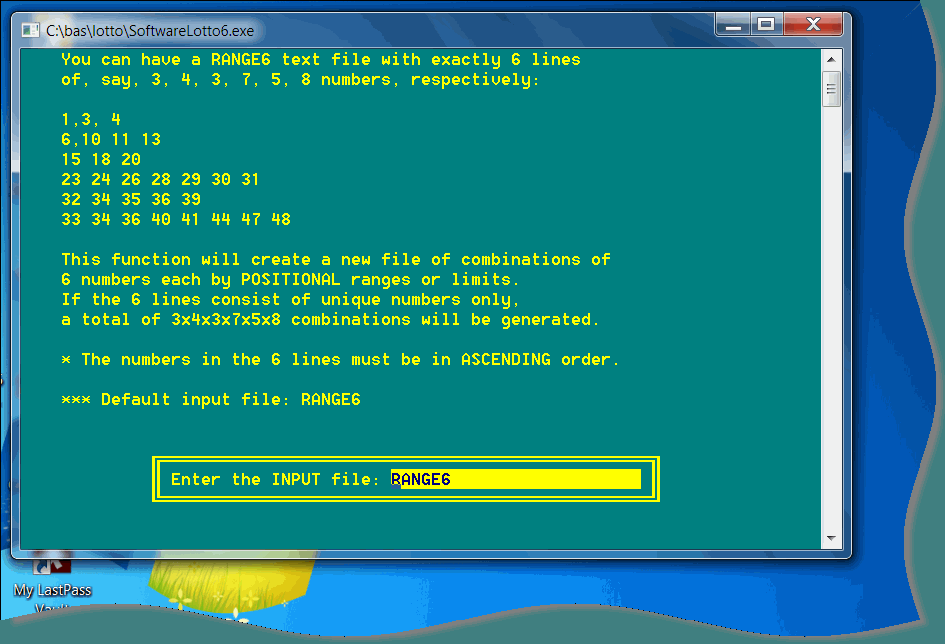
Very importantly, notice that the result files: WHEEL12.66 and POSIT6.3 are not equal in size. The numbers 1 through 12 generated 924 combinations. The positional ranges file generated 729 real lotto combinations. We might expect that the 1-12 file would hit 924/729 = 1.27 times more real lotto winners.
I used my lottery software WINNERS to check for 3, 4, 5, 6 winners against the UK draws file UK-6 (642 lotto drawings).

The reports follow. The input file name (with real lotto results) is UK-6.
LOTTO-6 Winning Number Checking
Files: POSIT6.3 (729) against UK-6 (642)
Date: 07-31-2002
Line Combinations 6 5 4 3
no. Checked Hits Hits Hits Hits
1 1 13 22 29 37 45 in draw # 52
1 1 13 22 29 37 45 in draw # 59
1 1 13 22 29 37 45 in draw # 61
1 1 13 22 29 37 45 in draw # 163
........
729 3 15 24 32 39 49 in draw # 268
729 3 15 24 32 39 49 in draw # 294
729 3 15 24 32 39 49 in draw # 318
729 3 15 24 32 39 49 in draw # 328
729 3 15 24 32 39 49 in draw # 379
Total Hits: 0 21 606 9219

The positional ranges registered the following hits:
- 6 winners: 0
- 5 winners: 21
- 4 winners: 606
- 3 winners: 9219
The WHEEL12.66 file (numbers 1 through 12) registered the following hits:
- 6 winners: 0
- 5 winners: 7
- 4 winners: 497
- 3 winners: 10458
WHEEL12.66 fared clearly worse! Yet, it had 1.27 times more lotto combinations!
The WHEEL12.66 file (numbers 1 through 12) should have registered the following hits:
- 6 winners: 0
- 5 winners: 27
- 4 winners: 770
- 3 winners: 11708
to maintain size parity.
We can also notice that the higher the lotto prize, the worse the 1 to 12 consecutives file fares. The performance gap widens from low prizes to the jackpot. The 1-2-3-4-5-6 lotto combo performs better at the 3 of 6 prize level ... far better at the 2 of 6 lotto prize level!
See also the interesting role played by the average: SuperFormula: Definitive Probability, Gambling Software.
The probabilities are equal, but the lotto combinations are not equal. As George Orwell put it: "Some animals are more equal than others."
There is a connection to the material I presented in this essay:
Writer: Computer software that writes random words, sentences.
One can run Writer lotto software millions of times and not get an output consisting of 20 sentences that mean something in any natural language. One strong attribute of Almighty Randomness. Only humans (or any creature belonging to the intelligent life in the Universe) override randomness.
Humans oppose Randomness using the rational tool named Rule. The rule expects a strict result, not a random result. The rule, for example, is: Plot all the points equally distant from a fixed point (the center). The strict result is the geometrical figure known as circle. Things are relative, however. There is no strict or absolutely certain result. A multitude of factors (all of them random!) can prevent the human subject from carrying out a rule. Besides, the opposition to Randomness is ephemeral in the complexity of universal time.
There is another organic connection to the material I presented in this article:
Probability of Perfect Shapes in Nature: Rivers, mountains, trees.
There is no evidence of perfect shapes (geometrical shapes) on Earth or in the Universe. Randomness creates random forms of matter. Only humans create relatively perfect shapes in an attempt to control randomness. All shapes have, however, the same probability of appearance. Reality only has a different idea!
There has been thousands of lotto drawings conducted worldwide. We should have seen by now a lottery combination of the type 1 2 3 4 5 6. There has been none so far.
The combination lotto 123456 seems to be heavily ordered (compliant with a strong rule). The words of natural languages are also heavily ordered by the rules of grammar, and syntax, and pronunciation, etc. Writer probability software will not generate any meaningful sentence in any language any time soon. Nor will it generate the meaningless first letter permutations or arrangements abcbde fghijklm nop rstuv, etc.
Here is a sample report for a statistically large data file in Pennsylvania 5/39 lotto game.
             Statistics for file: C:\LOTTERY\LOTTO-5
             Total lotto drawings:  3768

      Drawings                 Sum   Root   Average   StdDev    AvgDev    AvgDel

   1  16  19  22  26            84    3       16.80     8.57      6.64      6.25
   9  11  13  22  38            93    3       18.60    10.67      9.12      7.25
   8  14  23  28  29           102    3       20.40     8.16      7.52      5.25
  19  22  27  31  38           137    2       27.40     6.71      5.68      4.75
....
 Medians:                      100    5       20.00    10.03      8.64      6.75
The median of standard deviation (StdDev) is very close to the theoretical value calculated by the Fundamental Formula of Gambling (FFG). Lotto combination 1 2 3 4 5 has a standard deviation of 1.41. It is a far cry from the median (10.03)! Furthermore, you can use PermuteCombine to generate all lotto combinations in lexicographic order for any game. Beware! The output files can be extremely large! Run Sums to analyze the entire lotto file. Again, the median of standard deviation and the theoretical value calculated by the Fundamental Formula of Gambling are virtually identical. The negligible differences are induced by the use of transcendental numbers (results of calculations of square roots, logarithms, etc.)
"For only Almighty Number is exactly the same, and at least the same, and at most the same.
May Its Almighty Randomness grant us in our testy day the righteous proportion of being at most unlikely the same and at least likely different. For our strength is in our inequities."
 Read Ion Saliu's first book in print: Probability Theory, Live!
~ Founded on valuable mathematical discoveries with a wide range of scientific applications, including the organic connection between probability theory and the role of standard deviation in generating random phenomena such as lotto combinations.
Resources in Theory of Probability, Mathematics, Statistics, Combinatorics, Software
See a comprehensive directory of the pages and materials on the subject of theory of probability, mathematics, statistics, combinatorics, plus software.
Home | Search | New Writings | Software | Odds, Generator | Contents | Forums | Sitemap